
16 April to 23 May 2026
This project began with an examination of a presentation Naqvi gave in the second grade about where she was ‘from’. This moment intimates the familiar experience of many first-generation immigrants, being asked, early in life, to perform a simplified and palatable performance to highlight cultural differences.
In the current political climate, proved by relentless media cycles and the normalization of anti-migration policies across Western nations, those fleeing persecution, war, and political and economic instability are being routinely and forcefully demonized. Migration is reduced to a calculus of value: which bodies are deemed productive, which expendable. One body registers as profit; another as loss.
The title of this exhibition is pulled from British Prime Minister Keir Starmer’s White Paper strategy on immigration, where he warned that without stronger integration “we risk becoming an island of strangers.” Naqvi adopts this phrase critically, reflecting on how migrants are ambiguously framed by contemporary political rhetoric as social and economic threats. As in much of her practice, Naqvi works with found photography and personal memory to examine her own experience of migration, fraught with the afterlives of settler-colonialism.
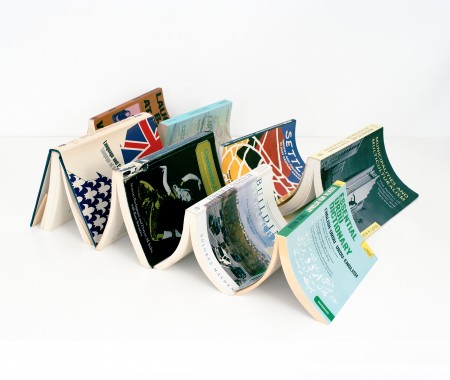
Naqvi pulls books from her parents’ collection, images from the original poster made for this school project, and looks at tourism photos used to promote her motherland of Pakistan. She also works with cyanotypes to create traces, maps, and blueprints pairing together text and images from across multiple periods in recent history.
In Arabic the word for universe, 'alam', and the word for knowledge, 'ilm', share their origin in the word, 'alamah', meaning 'a mark'. To make a mark, to draw a line, is a way of knowing the world. Unlike the colonial approach of drawing lines to divide and enclose, Rajani explores how traditions of mark-making enable us to tether ourselves to each other, our communities and sacred landscapes.
Through her long-term project, Rajani centres practices and lineages of drawing and painting through which coastal communities in Pakistan remain connected to sacred ecologies of rivers and sea amidst the violence and erasure of infrastructure.
For fisher communities, the meeting of the river and sea is a sacred union giving birth to all life and land. As rivers are barraged, mined and ravaged, elders explain that the sea is coming forward in search of its beloved, the river. In the midst of this ongoing catastrophe, new practices of visual expression and devotion emerge, through which communities return the river to the sea, land to water, and art to the promise of survival.
These expansive visual practices draw on older Islamic traditions of drawing talismans and charms for protection, remembrance and recovery. While conservative revisionings of Islam have sought to erase the centrality of image-making, the works presented explore how these mystical practices have persisted, transformed and survived.